Feature Flags in Next.js: Safer Deploys, Rollbacks Without Drama
What feature flags are, how they fit into Next.js, real experience with LaunchDarkly, how to prevent flag debt, and a rundown of the main alternatives.
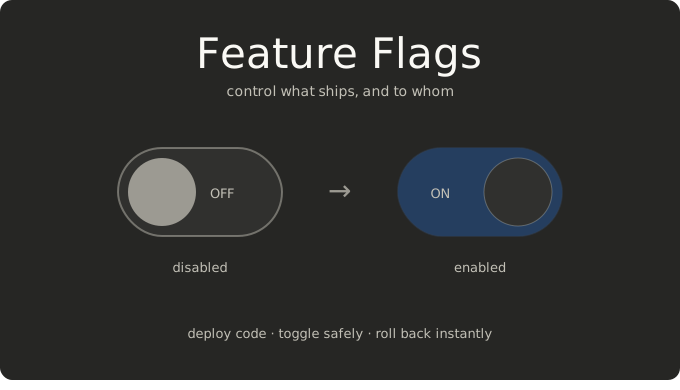
A feature flag (or feature toggle) is a runtime decision your app makes: "is this part of the product active for this user, in this environment, right now?" It doesn't replace good design or tests — but it changes how safely and gradually you can move code to production.
Why I Use Them for Every New Feature
When I'm building something new, I wrap it in a flag unless it's trivial and reversible in seconds. The reasons are practical:
- Rollback without a redeploy: if something goes wrong in production, you turn off the flag and restore the previous behavior without waiting on a full pipeline. The fix can come later, without pressure.
- Audience-based rollout: you can show a change only to a specific customer, a percentage of users, a country, or beta testers, while everyone else stays on the stable version.
- Less fear of merging: code ships to
mainbehind the flag, which means shorter-lived branches and fewer big merge conflicts.
How to Prevent Flag Debt
Flags that nobody removes turn into dead conditions that nobody dares touch. The process that works for me is simple: for every flag I create, I open a tech debt ticket and add a TODO in the code with a link to that ticket.
// TODO: remove flag once rollout is complete
// Tech debt: https://linear.app/your-team/issue/ENG-123
if (featureFlags.isEnabled('new-checkout', user)) {
  showNewCheckout();
}
This way, during any backlog cleanup session, the task shows up and doesn't get forgotten. It doesn't require heroic discipline — just a consistent process.
How They Fit into Next.js
The challenge with Next.js is coordinating server and client. The HTML the server generates and what React hydrates need to tell the same story — especially when the flag affects visible UI or important data.
- Server Components / RSC: evaluate the flag on the server when the result needs to influence the initial HTML or sensitive data. A "per-user" flag implies dynamic content — you can't use static caching for that.
- Client Components: useful for UI that changes after hydration, or details that don't affect the first render. Avoid divergence between what the server and client show.
- Middleware: works well for early redirects or routing experiments. Not the right place for complex business logic.
- User identity: for customer-level segmentation you need a stable identifier — account, tenant, signed cookie. Without identity, you can only do anonymous percentages or environment-based rules.
LaunchDarkly: Real-World Experience
I've worked extensively with LaunchDarkly and the React integration has been solid. The hooks and components fit naturally into the "read remote state and re-render" mental model. The backend support (Node, other runtimes) is also good — you can make the same flag decision in API routes and backend services, with targeting rules that stay in sync.
What I use most day-to-day:
- Turning changes on and off from the dashboard, without touching code.
- Variants and A/B testing: not just booleans — useful when you want to measure the impact of a change, not just hide it.
- E2E tests with Playwright: you can force flags to known values so critical paths don't depend on a random experiment state, eliminating flakiness.
Other Options
Depending on your budget, whether you want to self-host, or how tightly you want to be coupled to your platform, there are good alternatives:
- Vercel Flags SDK: native Next.js integration, supports precompute for static pages. Docs.
- Statsig: solid tools for rollouts and experimentation. Guide.
- ConfigCat: step-by-step tutorial with SSR. Tutorial.
- Flagsmith: open source, with guides for App Router. Example on DEV.
- GrowthBook, Unleash, Flipt: other open-source options with different levels of complexity.
- Environment variables: for simple cases where the flag doesn't change at runtime, this is sometimes enough.
The tool matters less than having a clear contract: who evaluates the flag, with what identity, and how the impact is observed in logs or analytics.
A Brief History: How Teams Controlled Releases Before Feature Flags
Feature flags feel obvious today. But before dedicated platforms existed, teams still needed ways to hide unfinished work and reduce release risk. Everything was more manual and more fragile.
When Deploy Meant Release
If code was in production, users could see it. Every deploy carried risk, bugs were instantly user-facing, and rolling back meant redeploying. That pressure pushed teams to find ways to hide incomplete work.
Long-Lived Branches
The most common solution: don't merge until it's ready. Engineers worked in isolation for days or weeks, then merged only when the feature was complete. The result was painful merge conflicts and integration issues discovered too late. Instead of reducing risk, this approach almost always just delayed it.
Environment Variables and Database Flags
Some teams started adding basic conditionals with environment variables — a step forward, but requiring a redeploy for any change. The next level was using the database to control features dynamically: no redeploy, basic targeting. But no UI, no audit logs, and logic scattered across the codebase. Many companies still run versions of this today.
Infrastructure-Level Canary Releases
Routing a percentage of traffic to servers running the new version worked, but was coarse-grained, not user-specific, and hard to turn off instantly.
What Changed
Across all these approaches, the same problems kept showing up: no real-time control, all-or-nothing releases, slow rollbacks. What modern platforms changed wasn't the concept — conditional logic already existed. What changed was the abstraction and discipline around it. Deploy became routine. Release became a decision.
Summary
Feature flags are an operational lever: safer deployments, fast rollbacks, and real-audience testing. With the tech debt ticket + TODO in code process, you also prevent them from turning into debt nobody cleans up. LaunchDarkly has been a reliable choice in my experience, but the ecosystem is broad — pick based on your team, your requirements, and how you want to monitor impact in production.